The Regent Kings And Their Contributions
Pandya Dynasty in Madurai
(Ref.: https://en.wikipedia.org/wiki/Pandya_dynasty)
The Pandya empire with capital in Madurai was home to temples including Meenakshi Temple in Madurai, and Nellaiappar Temple in Tirunelveli. Traditionally, the legendary Sangams (congregation of Tamil poets who created the great Sangam literature) were held in Madurai under their patronage, and some of the Pandya Kings were poets themselves. The early Pandya Dynasty of the Sangam Literature faded into obscurity upon the invasion of the Kalabhras.
The Later Pandyas (1216–1345) entered their golden age under Maravarman Sundara Pandyan and Jatavarman Sundara Pandyan (c. 1251). The Pandyas lost their capital city Madurai to Madurai Sultanate in 1335
The following is a partial list of Pandya emperors who ruled during the Sangam age:[61][62]
Pandyan Empire, 8th century CE
- Koon Pandyan
- Nedunjeliyan I (Aariyap Padai Kadantha Nedunj Cheliyan)
- Pudappandyan
- Palyagasaalai Mudukudumi Peruvaludhi
- Nedunjeliyan II
- Nan Maran
- Nedunj Cheliyan III (Talaiyaalanganathu Seruvendra Nedunj Cheliyan)
- Maran Valudi
- Kadalan valuthi
- Musiri Mutriya Cheliyan
- Ukkirap Peruvaludi
Pandyan Empire, 13th century
The 13th century is the greatest period in the history of the Pandya Empire. This period saw the rise of seven prime Lord Emperors (Ellarkku Nayanar – Lord of All) of Pandya, who ruled the kingdom alongside Pandya princes. Their power reached its zenith under Jatavarman Sundara Pandyan in the middle of the 13th century. The foundation for such a great empire was laid by Maravarman Sundara Pandyan early in the 13th century.[71][72]
- Parakrama Pandyan II (king of Polonnaruwa) (1212–1215 CE)
- Maravarman Sundara Pandyan(1216–1238 CE)
- Sundaravarman Kulasekaran II (1238–1240 CE)
- Maravarman Sundara Pandyan II (1238–1251 CE)
- Jatavarman Sundara Pandyan (1251–1268 CE)
- Maravarman Kulasekara Pandyan I (1268–1310 CE)
- Sundara Pandyan IV (1309–1327 CE)
- Vira Pandyan IV (1309–1345 CE)
Pearl fishing during the Pandyan rule
Pearl fishing was an industry that flourished during the Sangam age. The Pandya port city of Korkai was the center of pearl trade. Written records from Greek and Egyptian voyagers give details about the pearl fisheries off the Pandya coast. The pearls from the Pandyan Kingdom were also in demand in the kingdoms of north India. Several Vedic mantras refer to the wide use of the pearls. The royal chariots were decked with pearls, as were the horses that dragged them. The use of pearls was so high that the supply of pearls from the Ganges could not meet the demand.
The Madurai Nayak Dynasty
The Madurai Nayaks were Telugu rulers from around 1529 until 1736, of a region comprising most of modern-day Tamil Nadu, India, with Madurai as their capital. The Nayak reign was an era noted for its achievement in arts, cultural and administrative reforms, revitalization of temples previously ransacked by the Delhi Sultans, and inauguration of a unique architectural style.
The dynasty consisted of 13 rulers, of whom 9 were kings, 2 were queens, and 2 were joint-kings. The most notable of these were the king, Tirumala Nayaka, and the queen, Rani Mangammal. After the Nayak dynasty took over Madurai, it raised the Madurai country to a high level of administration and cultural life. (Ref.: https://en.wikipedia.org/wiki/Madurai_Nayak_dynasty)
Tirumalai Nayak
Tirumala Nayaka was the most powerful and best-known member of his dynasty, who ruled Madurai for thirty-six eventful years. Before Tirumala Nayaka came to power, the court of Madurai was being held at Trichy for some ten to twelve years. Tirumala Nayaka would have continued to rule from Trichy but for a dream. Tirumala Nayaka was suffering from Catarrah which the royal physicians were unable to cure. While he was once marching towards Madurai, Tirumala Nayaka’s sickness worsened and he halted near Dindigul. When he slept in his tent, God Sundareshwara and Goddess Meenakshi appeared to him in a dream, and mentioned that they would cure him if he would make Madurai his capital.
As soon as he awoke from his dream just before dawn, Tirumala Nayaka called for the Brahmans (learned scholars) and others in attendance, who advised him to obey the will of God. Tirumala Nayaka then not only vowed to make Madurai his capital but also to expend 5 lakh pons (100,000 pounds) in sacred works. Immediately thereafter, he felt the disease leave him. An overjoyed Tirumala Nayaka thereafter determined to devote his life to the worship and service of the Gods of Madura and supposedly adopted the Shaiva (worship of Paramasiva) faith.
Rani Mangammal, the regent queen of the Nayak Rule reigned from 1689– 1704 C.E. Born in Madurai, she was the regent queen on behalf of her grandson. She was a popular administrator and is still widely remembered as a maker of roads and avenues, and a builder of temples, tanks and choultries with many of her public works still in use. She is also known for her diplomatic and political skills and successful military campaigns. The capital of Madurai Kingdom during her times was Tiruchirapalli.
Rangakrishna Muthu Virappa Nayak (1682—1689), Mangammal’s son succeeded Chokkanatha, aged fifteen. He tried to retrieve the diminished fortunes of the kingdom and made a name for himself by courageously ignoring Aurangzeb. But Rengakrishna died in 1689, when his queen was pregnant. After she gave birth to a son, Vijaya Ranga Chokkanatha, she committed sati, despite strong remonstrance by her mother-in-law Mangammal. So Mangammal was forced to become regent on behalf of her infant grandson Vijaya Ranga Chokkanatha, who was crowned when he was three months old in 1689 and ruled till 1705, with an able administrative council headed by Dalavoy (Governor General) Narasappiah. She was able to maintain the prestige of Madurai and regain for it much of the position it had held during the days of Thirumalai Nayak.
Many irrigation channels were repaired, new roads were constructed, and avenue trees were planted. The highway from Cape Comorin was originally built during the time of Mangammal and it was known as Mangammal Salai. She built many public works, notably the Choultries for pilgrims, of which the Mangammal Chataram (Choultry) in Madurai near the railway station is a standing monument. Popular belief ascribes to her every fine old avenue constructed in Madurai and Tirunelveli and other smaller towns in Tamil Nadu.
Her own original palace (Tamukkam or Summer Palace) in Madurai hosted royal entertainments such as elephant fights. She also provided comfort to highway travelers and pedestrians by planting trees, building inns and supplies of water. In 1701 she made large grants for a public feeding institute. Mangammal donated considerable jewels, palanquins to the Madurai Meenakshiamman Temple and similar endowments to numerous temples in her Kingdom. (Ref.: https://en.wikipedia.org/wiki/Mangammal)
Architectural contributions of The Nayaks
The Nayaks made great contributions to the architectural style during this period. Their contributions being the elaborate mandapas of the “hundred-pillared” and “thousand-pillared” types, the high gopurams (temple towers) with stucco statues on the surface and the long corridors.
The main temples representing this style in and around the Madurai region are:
- The Ranganatha temple at Srirangam – noted for its increase in the number of enclosures;
- The temple at Rameswaram – noted for its long corridors;
- Meenakshi Temple at Madurai – Noted for the great splendour its “thousand-pillared” mandapam, and the thanga thamari kulam (“Golden Lotus Water Pool”).
Invasions Of The Mughals In The Kingdom of Madurai
South India was hugely rich and has traded with the western world since the time of king Solomon and it was well known through the world as a treasure trove of gems and gold. So every invader wanted it.
By 1310, Mughal invader Sultan Ala-ud-din Khilji of the Delhi Sultanate had forced the Yadava and Kakatiya rulers of Deccan region in southern India to become his tributaries. During the 1310 Siege of Warangal against the Kakatiyas, Alauddin’s general Malik Kafur had learned that the region to the south of the Yadava and Kakatiya kingdoms was also very wealthy. After returning to Delhi, Kafur told Alauddin about this, and obtained permission to lead an expedition to the southernmost regions of India
General Malik Kafur, army general of Sultan Ala-ud-din Khilji, besieged the Hoysala capital Dwarasamudra with 10,000 soldiers, and forced the Hoysala king Ballala to become a tributary of the Delhi Sultanate. Following that, in March – April 1311, he entered South Tamilnadu.
Malik Kafur started his march towards the Pandya territory (called Ma’bar in Muslim chronicles) from Dwarasamudra on 10 March 1311, and reached the Pandya frontier five days later. The Delhi courtier Amir Khusrau mentions that, during this march, the Delhi army covered a difficult terrain, where sharp stones tore horse hoofs, and the soldiers had to sleep on ground “more uneven than a camel’s back” at night.
In South Tamilnadu including Madurai, Malik engaged in ruthless murder, rape and looting. The result was devastating in Tamilnadu. (Ref.: https://en.wikipedia.org/wiki/Malik_Kafur%27s_invasion_of_the_Pandya_kingdom). He executed huge plunder, including elephants, horses, gold and precious stones. By late April 1311, Kafur, who had collected a huge amount of wealth from Hoysala and Pandya kingdoms, decided to return to Delhi. According to Alauddin Khalji’s courtier and chronicler Amir Khusrau, the Delhi army of Malik Kafur had captured 512 elephants, 5,000 horses and 500 manns (1 mann = 37.324 kg. So therefore 18.662 tonnes of gold was looted) of gold and precious stones by the end of its Southern campaign against the Hoysalas and the Pandyas. Another account by writer Ziauddin Barani records the loot at included 612 elephants; 20,000 horses; and 96,000 manns of gold. Barani describes this seizure of wealth as the greatest one since the Muslim capture of Delhi. Malik Kafur took the wealth in sacks of gold and boxes of jewels at the point of the sword. It is said that the Pandyan ruler agreed to give away his entire treasury, all of his elephants in exchange for the Meenakshi Amman Temple, Madurai, Tamil Nadu, India.
How the Madurai Shiva Lingam, the Goddess and other deities were saved from destruction
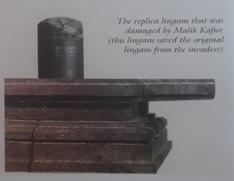
The Tamil Chronicles indicate how the temple at Madurai suffered vandalism under the Muslim rule. The Madurai Sthanikar Varalaru (a publication. Sthanikar – trustee; varalaru – history) gives a detailed account of the tribulations of the time. The Sthanikars (trustees) of the temple made a kilikoondu (cage) for the Shiva Linga in the garbha griha (main sanctum sanctorum). They raised earth mounds, blocked the garbha griha entrance and built a stone wall to protect the original lingam from the invaders. Further a replica of the original lingam was set up in the Ardha mandapam (intermediary pillared space between the temple exterior and the sanctum sanctorum or the other mandapas of the temple.)
They also setup the Goddess – Moola Peru Nachiyar – on the upper story of the vimanam (temple tower) and performed ashtabandhanam for her. They further carried out Pupadanam (burying in the ground) for the deities in the Muchukundeshwars shrine
Khusrau states that the Pandya territory was protected by a high mountain, but there were two passes on either side of the mountain. He names these passes as Tarmali and Tabar, which can be identified with present day Taramangalam and Thoppur. The Delhi army marched through these passes, and encamped on the banks of a river (probably Kaveri). Next, the invaders captured a fort, which Khusrau calls “Mardi”. The Delhi army massacred the inhabitants of Mardi.
Next, Malik Kafur marched to Vira Pandya’s headquarters, called “Birdhul” by Amir Khusrau. This is same as “Birdaval”, which is named as the capital of the Ma’bar country (the Pandya territory) in Taqwīm al- buldān(1321), a book by the Kurdish writer Abu’l-Fida. British scholar A. Burnell identified Birdhul as present day Virudhachalam.
At Birdhul, the Delhi army found a contingent of around 20,000 Muslim soldiers in the Pandya service. These soldiers deserted the Pandyas, and joined the Delhi army.instead of killing them for being apostates, the Delhi generals decided to spare their lives.
With help of the Muslim deserters, the Delhi army tried to pursue Vira Pandya, but had to retreat because of heavy rainfall. According to the Khusrau, the rural areas were so flooded that “it was impossible to distinguish a road from a well”. A large part of the Delhi army encamped at Birdhul, while a small party went out in search of Vira Pandya despite the heavy rains. At midnight, the unit brought the news that Vira Pandya was at Kannanur.
The Delhi army marched to Kannanur in heavy rains, but by this time, Vira had escaped to a forest with some of his followers. When the rains stopped, the invaders captured 108 elephants loaded with pearls and precious stones. They massacred the residents of Kannanur.
The Delhi generals wanted to find Vira Pandya, so that they could force him into becoming a tributary to the Delhi Sultanate. They suspected that Vira Pandya had fled to his ancestral fort of Jal-Kota (“water fort”, identified with Tivukottai). They started marching towards Jal-Kota, but people coming from that place informed them that he was not there. Ultimately, the Delhi generals decided that finding Vira Pandya was a hopelessly difficult task, and decided to return to Kannanur.
According to Khusrau, the next morning, the Delhi army learned that the town of Barmatpuri had a golden temple, with several royal elephants roaming around it. S. Krishnaswami Aiyangar identified Barmatpuri as “Brahmapuri” (Chidambaram), whose Nataraja Temple had a golden ceiling.
The Delhi army reached Barmatpuri at midnight, and captured 250 elephants the next morning. The invaders then plundered the golden temple, whose ceiling and walls were studded with rubies and diamonds.They destroyed all the Shiva lingams (called “Ling-i-Mahadeo” by Khusrau), and brought down an idol of Narayana (Vishnu). Khusrau mentions that the ground that once smelled of musk now emitted a stench of blood.
From Barmatpuri, the Delhi army marched back to its camp at Birdhul, where it arrived on 3 April 1311. There, the invaders destroyed the temple of Vira Pandya. The Delhi forces then arrived in Kanum (identified with Kadambavanam) on 7 April 1311. 5 days later, they reached Madurai (called “Mathura” by Khusrau), the capital of Sundara Pandya.
By this time, Sundara Pandya had already fled the city with his queens. The Delhi army first visited the temple of “Jagnar”, hoping to find elephants and treasures there. (H. M. Elliot translated “Jagnar” as “Jagannatha”, but historian S. Krishnaswami Aiyangar identifies “Jagnar” as “Chokkanatha”, an aspect of Madurai’s patron deity Shiva.) Malik Kafur was disappointed to find that only 2-3 elephants were left at the temple. This made him so angry, that he set fire to the temple.
The army started its return journey on 25 April 1311. In Delhi, Alauddin held a public court (darbar) at Siri on 19 October 1311, to welcome Malik Kafur and other officers of the army. He gave 0.5 to 4 manns of gold to his various nobles.
Ever after Malik Kafur left Tamil Nadu with the looted wealth in 1311, the Tamil nation laid devastated and demoralized. Tamil Nadu would never recover from it fully and achieve its past glory. The lost sovereignty was never recovered. The historic division of Tamil Nadu into three dynastic rules of Cheras, Cholas and Pandyas was no more. Neither the Cholas nor the Pandyas were strong monarchs any more.
After Malik Kafur left Tamil Nadu, there were a couple of more invasions from the Delhi Sultans. Much of Tamil Nadu became part of Sultan Mohammad-bin-Tughlug’s empire of the Delhi Sultanate for a period – approximately 1327 to 1335. Then the local commanders of the Delhi Sultanate rebelled against him and established their own rule as independent Madurai Sultanate (or Ma’bar Sultanate). Thus the Delhi rule over Tamil Nadu lasted for almost 8 years.
The Mughal invasion was that of Aurangzeb, the Mughal emperor from Delhi. The local Mogul commanders rebelled against Aurangzeb and established themselves as independent rulers (Nawabs). Thus started the Nawab rule over Tamil Nadu.
Colonial Rule In The Kingdom Of Madurai
With the birth of the 18th century, colonialism by European countries began.
After the Nawab rule, Europeans came to power in various parts of Tamil Nadu. European rule (primarily British rule) over Tamil Nadu lasted for almost two centuries. Thus before the British rule, Tamil Nadu was ruled from Delhi as part of some type of Indian empire for ten long years – first during the Delhi Sultanate of Mohammad-bin-Tughlug and then during the Mugha Empire of Aurangzeb.
The Portuguese, the Dutch, the French and the British came as traders from Europe. The Europeans soon became the masters of all the local rulers and demanded tribute. Those who obeyed were allowed to rule, those who refused were militarily defeated and their land handed over to other more subservient rulers or direct European rule was established. Eventually the British took control of all of Tamil Nadu with the exception of the small Pondicherry territory under the French. Pondicherry remained under French rule until the early 1950s.
Maruthupandyar (Maruthu Pandyar) ruled Sivagangai during the last part of the 18-th century. He became the ruler of Sivagangai which was paying tribute to the British. He continued to pay tribute for many years. Eventually he rebelled against the British and issued an Independence Proclamation from Thiruchi Thiruvarangam Temple on June 10, 1801. He called on the other local rulers to join hands with him and fight the British. Maruthu Pandyar and his allies were quite successful and captured three districts from the British. Seeing the deteriorating situation, the British brought in additional troops from Britain. They also got more troops from the British garrisons in the neighboring Ceylon (now called Sri Lanka). These forces surrounded Maruthu Pandyar’s army at Kalayar Koil, and the latter scattered. Maruthu Pandyar and his top commanders escaped. They regrouped and fought the British and their allies at Viruppatchi, Dindugal and Cholapuram. While they won the battle at Viruppatchi, they lost the other two battles. Maruthu Pandyar was captured at Cholapuram. He was hanged on October 24, 1801. He was the last Tamil ruler in Tamil Nadu to fight the British. The British conquest of Tamil Nadu was complete; all the local rulers paid tribute to them.
Maruthu Pandyar’s 1801 Independence Proclamation was the first such proclamation against the British. But you will not find any mention of it or of Maruthu Pandyar in Indian History texts.